
What are organic nutrients?
In gardening, organic nutrients are understood in opposition to the salts and chemicals synthesized industrially to produce mineral fertilizers.
Organic nutrients, on the other hand, come from once-living material – either plant or animal – that decomposes through microbial and fungal activity in the soil. This process ensures that the organic nutrients can be absorbed by plants to support healthy growth and development.
Sources of organic nutrients, therefore, are diverse and act as a fertilizer. They can include manure, bone meal, compost, bat guano, seaweed, and plant cuttings.
Organic nutrients are also naturally present in the soil but, over time and with intensive use, the soil can become depleted making it harder to grow healthy plants.
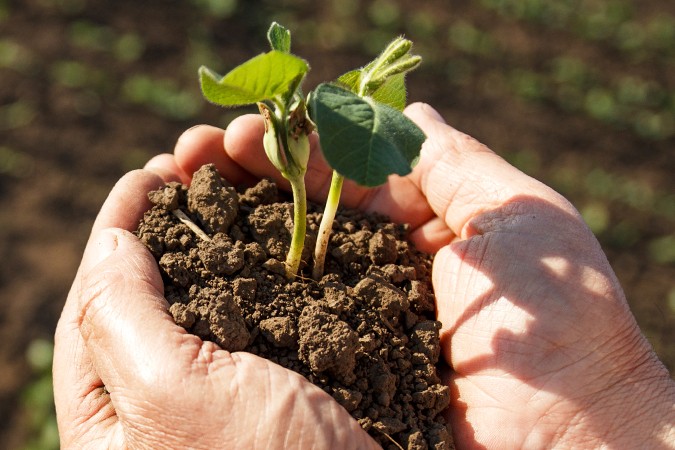
What organic nutrients do plants need?
All living things need nutrients to survive. Plants get the nutrients they require from the soil and surrounding environment through their root systems.
After the organic matter is broken down into nutrients, it must then dissolve in water so the roots of the plant can absorb it. The nutrients are then transported around the plant to support essential functions such as photosynthesis.
The nutrients that plants need in the largest quantities are nitrogen, phosphorous, and potassium, but the required amounts vary throughout the growth cycle. These are known as the primary nutrients and are commonly referred to as NPK, which relates to their respective letter in the periodic table of elements.
The NPK ratio, often seen on organic fertilizer packaging, refers to the relative quantities of each nutrient to help gardeners ensure they only add what is needed.
Most plants also require fairly large quantities of calcium, magnesium, and sulphur, which are referred to as secondary nutrients. Taken together, all six of these nutrients are categorized as the macronutrients most essential to healthy plant growth.
Most plants need a further 12 nutrients but in much smaller amounts. These are known as micronutrients, or trace elements.
How to ensure your plants get enough organic nutrients
So, plants need organic nutrients to grow healthily, but how to make sure they are getting enough? For that matter, it is equally important not to overload the soil with too many nutrients, but how do you know when it is too much?
Signs of nutrient deficiency and imbalance include yellowed leaves, 'burnt' leaf tips, unusually dark green foliage, and limited flowering.
Timing can be as important as quantities when it comes to nutrients. During the early stages of plant growth, all nutrients are required but nitrogen is especially critical as it helps with the vegetative growth necessary for future flowering. As such, you should consider using an organic fertilizer with a higher ratio of nitrogen, such as BAC's Organic Pellets or BAC's Organic Grow.
If you are transplanting plants into the soil from pots, then root-supporting nutrients like phosphorus and potassium become more beneficial. These nutrients are also crucial during the blossoming and fruiting stages, while nitrogen is best kept to a minimum. Using BAC's Organic PK Booster or BAC's Organic Bloom can help you find the right balance.
Organic nutrients for healthy plant growth: Key takeaways
- Organic nutrients derive from organic matter and support healthy plant growth.
- Plants take organic nutrients from the soil through their root systems.
- Plants need 18 or so nutrients to grow strong, although not all in the same quantities nor necessarily at the same levels throughout the growth cycle.
- Using organic fertilizers can help ensure plants get enough of the nutrients they need when they need them, especially those required in the largest quantities, like nitrogen, phosphorus, and potassium.
BAC Online contact details
Would you like more information about BAC products or our sales points?
- organic fertilizer
- how to use organic fertilizer
- what is natural fertilizer
- how to mix organic fertilizer
- organic fertilizer plants
- bloom boosters
- best organic fertilizers
- organic potassium fertilizer
- natural fertilizer
- flower booster
- fertilizing vegetables organically
- best bloom boosters
- organic nitrogen fertilizer
- natural fertilizer for plants
- advantages of organic fertilizer
- organic plant food
Translation not available